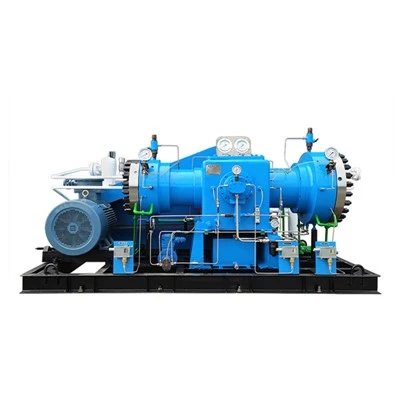
Calculating the power consumption of a gas compressor is a crucial aspect for both industrial users and suppliers. As a gas compressor supplier, understanding this process helps us provide accurate information to our customers, optimize compressor performance, and ensure cost - effective operations. In this blog, we'll delve into the key factors and methods for calculating the power consumption of a gas compressor.
Understanding the Basics of Gas Compressors
Before we start calculating power consumption, it's essential to understand what a gas compressor is. A Gas Compressor is a mechanical device that increases the pressure of a gas by reducing its volume. Compressors are used in various industries, such as oil and gas, chemical, and manufacturing, for tasks like gas transportation, refrigeration, and power generation.
There are different types of gas compressors, including reciprocating compressors, rotary screw compressors, and centrifugal compressors. Each type has its own characteristics, efficiency levels, and power requirements.
Factors Affecting Power Consumption
- Gas Properties
- Gas Type: Different gases have different physical properties, such as molecular weight, specific heat ratio, and compressibility factor. For example, compressing a heavy gas like Ammonia Compressor may require more power compared to a lighter gas like hydrogen because of its higher molecular weight.
- Inlet Conditions: The inlet pressure, temperature, and volume flow rate of the gas significantly impact power consumption. Higher inlet temperatures generally increase the power required for compression, as the gas needs to be cooled more during the compression process.
- Compression Ratio
The compression ratio is defined as the ratio of the discharge pressure to the inlet pressure of the compressor. A higher compression ratio means more work is required to compress the gas. For instance, if the inlet pressure is 1 bar and the discharge pressure is 10 bar, the compression ratio is 10. As the compression ratio increases, the power consumption of the compressor also rises. - Compressor Efficiency
The efficiency of a compressor is a measure of how effectively it converts input power into useful compression work. There are different types of efficiencies, such as isentropic efficiency, volumetric efficiency, and mechanical efficiency. A more efficient compressor will consume less power for the same amount of compression work. For example, a compressor with an isentropic efficiency of 80% will use more power than one with an isentropic efficiency of 90% to achieve the same compression.
Methods for Calculating Power Consumption
Isentropic Compression
Isentropic compression is an idealized process where the compression occurs without any heat transfer to or from the gas and with no internal irreversibilities. The power consumption for isentropic compression can be calculated using the following formula:
[P_{is}=\frac{\dot{m}RT_1}{\eta_{is}(k - 1)}\left[\left(\frac{P_2}{P_1}\right)^{\frac{k - 1}{k}}- 1\right]]

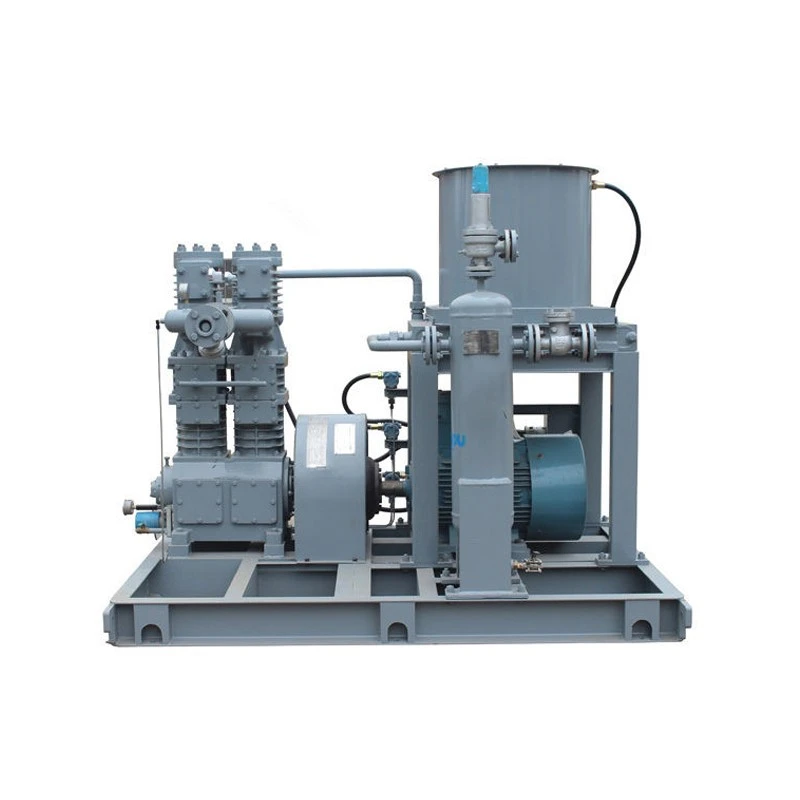
where:
- (P_{is}) is the isentropic power consumption (in watts)
- (\dot{m}) is the mass flow rate of the gas (in kg/s)
- (R) is the specific gas constant (in J/(kg·K))
- (T_1) is the inlet temperature of the gas (in K)
- (\eta_{is}) is the isentropic efficiency of the compressor
- (k) is the specific heat ratio of the gas
- (P_1) is the inlet pressure of the gas (in Pa)
- (P_2) is the discharge pressure of the gas (in Pa)
Polytropic Compression
In real - world scenarios, compression is not truly isentropic. Polytropic compression takes into account the heat transfer and internal irreversibilities. The power consumption for polytropic compression is calculated using:
[P_{poly}=\frac{\dot{m}RT_1}{\eta_{poly}(n - 1)}\left[\left(\frac{P_2}{P_1}\right)^{\frac{n - 1}{n}}- 1\right]]
where:
- (P_{poly}) is the polytropic power consumption (in watts)
- (\eta_{poly}) is the polytropic efficiency of the compressor
- (n) is the polytropic exponent, which is related to the heat transfer and irreversibilities during compression
Practical Considerations
When calculating power consumption in a real - world setting, there are several additional factors to consider:
- Cooling Requirements
Compression generates heat, and most compressors require cooling to maintain optimal performance. The power required for the cooling system, such as fans or water pumps, should be added to the overall power consumption calculation. - Mechanical Losses
There are mechanical losses in the compressor due to friction in bearings, seals, and other moving parts. These losses can be estimated based on the compressor design and operating conditions and should be factored into the power consumption. - Variable Load Conditions
In many applications, the compressor operates under variable load conditions. For example, in a refrigeration system, the compressor may need to adjust its capacity based on the cooling demand. In such cases, the power consumption calculation should account for the different load levels and the associated efficiency changes.
Importance of Accurate Power Consumption Calculation
Accurate power consumption calculation is beneficial for both suppliers and users. For suppliers, it helps in product design and optimization. By understanding the power requirements, we can develop more energy - efficient compressors and provide better technical support to our customers.
For users, accurate power consumption calculation allows for better cost management. They can estimate the operating costs of the compressor over its lifespan and make informed decisions when choosing a compressor. Additionally, it helps in energy conservation and meeting environmental regulations.
Case Study: Oxygen Compressor
Let's consider an example of an oxygen compressor. Suppose the inlet pressure (P_1 = 1) bar, the discharge pressure (P_2= 10) bar, the inlet temperature (T_1 = 300) K, the mass flow rate (\dot{m}=0.1) kg/s, the specific gas constant for oxygen (R = 259.8) J/(kg·K), the specific heat ratio (k = 1.4), and the isentropic efficiency (\eta_{is}=0.8).
Using the isentropic power consumption formula:
[P_{is}=\frac{\dot{m}RT_1}{\eta_{is}(k - 1)}\left[\left(\frac{P_2}{P_1}\right)^{\frac{k - 1}{k}}- 1\right]]
[P_{is}=\frac{0.1\times259.8\times300}{0.8\times(1.4 - 1)}\left[\left(\frac{10}{1}\right)^{\frac{1.4 - 1}{1.4}}- 1\right]]
First, calculate (\left(\frac{10}{1}\right)^{\frac{1.4 - 1}{1.4}}=\left(10\right)^{\frac{0.4}{1.4}}\approx1.93)
[P_{is}=\frac{0.1\times259.8\times300}{0.8\times0.4}(1.93 - 1)]
[P_{is}=\frac{7794}{0.32}\times0.93]
[P_{is}\approx22736] watts or 22.74 kW
Conclusion
Calculating the power consumption of a gas compressor is a complex but essential process. By considering factors such as gas properties, compression ratio, and compressor efficiency, and using appropriate calculation methods, we can accurately estimate the power requirements.
As a gas compressor supplier, we are committed to providing our customers with the most accurate information about power consumption. Our team of experts can assist you in choosing the right compressor for your specific application and help you optimize its performance to minimize power consumption.
If you are in the market for a gas compressor and want to learn more about power consumption and how it affects your operations, we encourage you to contact us for a detailed consultation. We look forward to discussing your needs and providing you with the best solutions for your gas compression requirements.
References
- Stoecker, W. F., & Jones, J. W. (1982). Refrigeration and Air Conditioning. McGraw - Hill.
- Shapiro, A. H. (1953). The Dynamics and Thermodynamics of Compressible Fluid Flow. Wiley.