



High Pressure Piston Compressors
The High Pressure Piston Compressors Manufacturer!
Shanghai Sollant Energy Saving Technology Co., Ltd. is a compressed air system manufacturer integrating R&D, production, sales, and service.


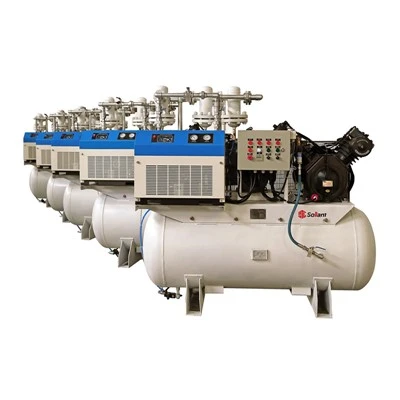


Why choose us
Quality Assurance
Sollant operates advanced production facilities and holds multiple international certifications such as iso9001 and ce, ensuring top-quality products that meet rigorous industry standards.
Good Service
Our professional manufacturing processes and dedicated r&d team allow us to deliver high-performance air compressors with fast lead times and reliable supply.
Fast Delivery
Sollant provides exceptional after-sales support with a skilled service team ready to assist customers worldwide.
Sales Market
Our main markets are in Europe and North America, which together account for over 70% of our total sales. We have established reliable distributor partnerships in key countries including the United States, Spain, Romania, Mexico, Iran, Saudi Arabia, Kenya, South Africa, Pakistan, Malaysia, Turkey, Australia, Ecuador, Russia, Kazakhstan, Uzbekistan, and more.
Technical Features
Air-End
This air-cooled air-end is designed for demanding medium- and high-pressure air and gas applications. Multi-stage compression reduces load per stage, while the single-acting, deep-finned cylinder increases unit reliability.
Carefully selected inlet, exhaust, and safety valves adapt to various operating conditions.
A heavy-duty inlet filter with silencer cleans the air or other gases entering the system.
Lubrication
The oil pump drives the lubrication system, providing perfect lubrication for every moving part. The lubricating oil system pressure is strictly monitored to ensure perfect lubrication of the unit. The oil filter precisely filters the lubricating oil to ensure unit safety.
Cooling
The highly efficient cooling system ensures low exhaust temperatures throughout the unit. Air-cooled or water-cooled coolers can be flexibly configured to meet application requirements. The interstage cooler and final stage cooler are integrated into a single unit. The main shaft drives a fan to provide forced cooling for the cooler and the main engine. Coolers and automatic condensate drains are installed between each compression stage.
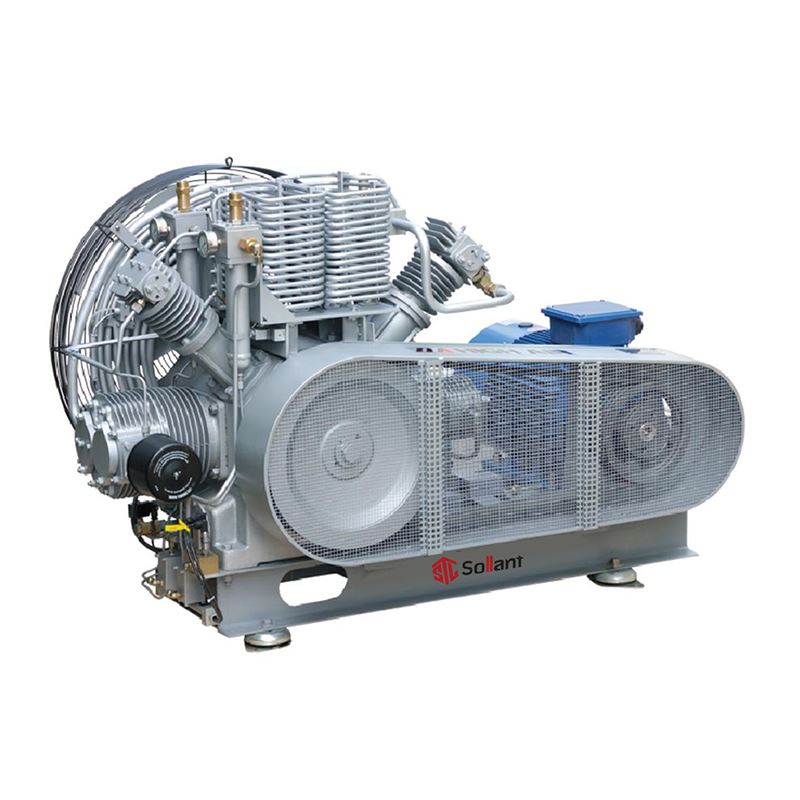
Head: The head is among the most vital areas of a piston compressor: it houses the pistons which compress air. Inside the head, a system of valves manages the intake and exhaust functions of the compression cycle - the heart of the compressor.
Engine: The engine, frequently an electrical motor, changes electrical power to mechanical power. This mechanical energy causes the piston to turn, permitting suction and then compression cyclically.
Tank: The compressed air is kept inside a storage tank. The capacity of the tank decides both the available compressed air and also the pressure levels which could be maintained, a crucial parameter for the compressor efficiency.
Retention Valve: This is called the check valve. Residue buildup or wear might lead retention valves to leak as time passes. These valves must be washed or replaced to always keep the compressor operating smoothly.
Pressure Switch: The pressure switch keeps the tank pressure between preset values and thus automatically runs the compressor. Whenever the pressure falls below a specific threshold, the pressure switch turns on the motor and then off, assuring a continuous source of compressed air.

Safety Valve: The safety valve is really an essential component for safety. It offers a fail safe system to release pressure when it exceeds safe levels to stay away from accidents and system damage. It needs regular manual activation and annual calibration.
Pressure Gauge:The pressure gauge shows the pressure in the storage tank visually. Its readings aren't exact, but it's a crucial instrument for safe operation and pressure monitoring.
Drain Valve: Moisture collects in the storage tank when a piston compressor is running. The drain valve removes this moisture to avoid corrosion along with other damages to the tank and components.
Oil Sight Glass: The oil sight glass provides for the monitoring of the engine oil level within the compressor to ensure adequate lubrication for the device for maximum performance along with a very long life. Regular oil checks and always keeping the recommended oil levels will prevent unnecessary wear and breakdowns.
Transmission Elements: The transmission system (pulleys and belts) transports mechanical energy from the motor to the compressor head. The pulleys move in the right direction for energy transfer and there are guard covers for the operator.
Different Types Of Piston Compressors
Single Acting Compressors
A single piston compresses air on one side of the cylinder. They are used for lower-pressure applications and are known for simplicity and reliability.
01
Double Acting Compressors
Double pistons compress air on both sides of the cylinder and are suitable for applications that require a continuous and high-pressure air supply.
02
Oil-Lubricated Compressors
Oil lubricates the piston and cylinder to reduce wear and tear and extend the compressor's life. They are used for heavy-duty applications and require regular maintenance to manage oil levels and prevent contamination.
03
Oil-Free Compressors
Special materials and coatings help reduce friction and wear; they have lubricated bearings and grease-free piston rings. They are suitable for applications where oil contamination is a concern, such as in the food and medical industries.
04
Multi-Stage Compressors
Multiple stages of compression achieve higher pressures. A multi-stage piston setup compresses air in successive stages, with each stage increasing the pressure further. They are suitable for applications that require air at very high pressure.
05
Applications across industries of High Pressure Piston Compressors
Manufacturing
Used for powering pneumatic tools, providing compressed air for production lines, and controlling various industrial processes.
Oil and gas
Essential for gas compression, transportation, and storage in the oil and gas industry, including natural gas pipelines and gas injection processes.
Food processing
Employed for packaging, food preservation, and maintaining sanitary conditions by providing compressed air for conveyor systems and equipment.
Pharmaceuticals
Used in critical applications such as pharmaceutical packaging and sterilization processes, where high-pressure, contaminant-free air is vital for product quality and safety.