



Oil-injected Screw Air Compressor
We hope to let you know our advantages and win-win cooperation in the least time.
The advantages of Sollant 7.5kw industrial air compressor
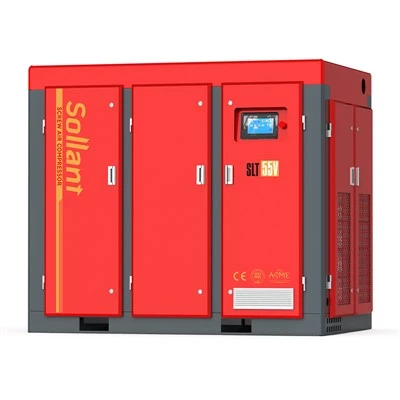
Sollant 7.5kW industrial air compressor has the characteristics of high efficiency and energy saving, stable and durable operation, and low noise.
We hope to let you know our advantages and win-win cooperation in the least time.
- Safe and Convenient of industrial air compressor
- Functions at extreme weather conditions
- They are designed to run tools that generate more power than typical equipment
- They are easier to maintain
- They are good energy conservers
- They consume less oil than other oil-flooded air compressors
Technical Specification
7.5kw industrial air compressor
Sollant 7.5kw rotary screw air compressor's pressure is adjustable, We can set the pressure according to your requirements(7-12bar), It's motor safety grade reached IP23/55 and. It weighs only 215 kg with 780mm length * 600mm width * 1020mm height. If you use it in the factory, we can also add air compressor frequency converter for your industrial air compressor. We can help you save 30-40% of your electricity costs.
If you want to be more competitive in your air compressor market, it is a very good opportunity with Sollant 7.5kw rotary screw air compressor.

The motor uses high-performance motors of well-known brands. Permanent magnet synchronous motors (PM motors) use high-performance NdFeB permanentmagnets which will not lose magnetism under 200 ° and its service life reaches as long as 15 years.
More Details
The motor has the function of temperature protection. It also has a wide range of motor speed regulation, high precision and wide range of volume regulation. The reliability is significantly improved with small size, low noise and large excess current.
The oil filter adopts high-density filter material, the surface is treated with nano-electroplating.High filtration accuracy effectively filters impurities in lubricating oil, prolongs the service life of the equipment.


Video
FAQ
Q: How do you choose the right oil-injected screw air compressor for your factory?
A: Selecting the right oil-injected rotary screw air compressor for a factory requires a comprehensive evaluation of several key factors: Air Quality Requirements: This is the primary consideration. Compressed air from oil-injected compressors contains trace amounts of oil (typically 3–5 mg/m³). If your factory operates in industries with stringent air quality standards-such as food processing, pharmaceuticals, electronics manufacturing, or precision coating-you may need to consider oil-free compressors or the installation of high-precision downstream filters. Airflow and Pressure (CFM and PSI): Calculate the total air consumption (CFM) of all pneumatic tools and equipment likely to operate simultaneously, then add a 25–30% margin to accommodate future expansion or potential pipeline leakage. Additionally, ensure the equipment can deliver the required operating pressure (PSI). Budget and Costs: Oil-injected rotary screw compressors offer a lower initial investment (e.g., approximately $500 per horsepower for fixed-speed models) and relatively simple maintenance. However, the long-term costs of periodic oil and filter replacements must be factored into the budget. Operating Mode: For factories with 24/7 continuous production, oil-injected rotary screw compressors are often the ideal choice due to their high efficiency, durability, and suitability for continuous operation.
Q: How does an oil-injected rotary screw air compressor work?
A: An oil-injected rotary screw air compressor is a type of positive-displacement compressor; its operating cycle comprises the following key steps: Intake and Filtration: Ambient air is drawn in through the intake valve and passes first through an air filter to remove dust and particulate matter. Compression: The filtered air enters the compression unit, where a pair of intermeshing helical rotors (male and female rotors) rotate at high speed. As the rotors mesh, the volume of air trapped between the rotor lobes gradually decreases, thereby compressing the air. Oil Injection: During the compression process, a large amount of cooling lubricant is injected into the compression chamber. The oil serves three purposes: Lubrication: Forms an oil film between the rotors to reduce friction and wear. Cooling: Absorbs the significant heat generated during air compression to control the temperature rise. Sealing: Fills the minute clearances between the rotors and the housing to minimize leakage and improve compression efficiency. Oil-Air Separation: The high-temperature oil-air mixture resulting from compression enters the oil-air separation tank. Through centrifugal force and the action of the separator, the majority of the oil is separated out; it is then cooled, filtered, and recirculated into the compressor for reuse. Output: The separated compressed air passes through an aftercooler and a precision filter before finally being delivered-via the minimum pressure valve-to an air receiver tank or the factory's compressed air distribution network.
Q: What is the difference between oil-injected and oil-free screw compressors?
A: The fundamental difference between oil-injected and oil-free screw compressors lies in whether lubricating oil is introduced into the compression chamber. This distinction leads to the following systemic differences: Air Quality: The discharge from oil-injected compressors contains trace amounts of oil mist (at the mg/m³ level), making them unsuitable for applications requiring zero oil contamination; oil-free compressors can achieve Class 0 purity standards. Energy Efficiency: Oil-injected compressors benefit from effective oil-film sealing and minimal internal leakage, while oil injection facilitates near-isothermal compression; consequently, for the same power consumption, their air delivery is 10%–20% higher than that of oil-free models. In contrast, oil-free compressors suffer from lower efficiency due to backflow leakage caused by rotor clearances. Cost Structure: Oil-injected compressors have a low initial purchase cost (approximately half that of oil-free units), with routine maintenance primarily involving oil and filter changes. Oil-free compressors are expensive to purchase; while they eliminate ongoing oil-related costs, major overhauls-such as replacing bearings and gears or refurbishing coatings-incur extremely high expenses. Application Scenarios: Oil-injected compressors are suitable for general industrial sectors such as metallurgy and machinery manufacturing, whereas oil-free compressors are essential for industries sensitive to oil contamination, such as pharmaceuticals, electronics, and food processing.
Q: What are the advantages and disadvantages of oil-injected screw air compressors?
A: Advantages: High Efficiency: Oil injection provides excellent sealing and cooling, resulting in very high compression efficiency; for units under 50 kW, adiabatic efficiency can exceed 90%. High Reliability: Simple design (no timing gears required) and minimal component wear make it suitable for continuous, heavy-duty 24/7 operation, with a typical design life of over 10 years. Smooth, Quiet Operation: The oil helps dampen vibration and noise, making the unit much quieter than piston compressors. Relatively Simple Maintenance: Maintenance focuses primarily on the oil system, with routine procedures for changing oil and filters. Disadvantages: Oil-Contaminated Compressed Air: The output air contains trace amounts of lubricating oil, making it unsuitable for industries extremely sensitive to oil contamination; expensive downstream purification equipment is required. Periodic Oil Changes Required: Lubricating oil degrades over time and with use, necessitating regular replacement, which incurs ongoing consumable costs and downtime. Environmental Concerns: Waste oil must be disposed of properly to prevent environmental pollution.
Hot Tags: oil-injected screw air compressor, China oil-injected screw air compressor manufacturers, suppliers, factory, 75KW VSD Rotary Screw Air Compressor, 315KW VSD Rotary Air Compressor, 250KW VSD Rotary Screw Air Compressor, 132KW VSD Screw Air Compressor, 22KW VSD Screw Air Compressor, 30KW VSD Rotary Air Compressor
Previous
No InformationYou Might Also Like




Send Inquiry