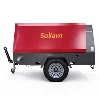
Ask a brewery engineer whether they run "an air compressor" and you will usually get a one-word answer. But a modern brewery does not have a single air demand. It has two different ones, and they rarely belong on the same machine.
Some duties need clean, pressurised air at 6 to 8 bar to fire a valve or drive a filler. Others need a steady flood of air at low pressure to aerate wort or keep a tank healthy. Reaching for an oil-free compressor for every job is as costly as assuming a blower can handle your packaging line. The real question is not "compressor or blower?" but "what is each brewery process actually asking for?" This article maps those processes to their pressure and flow needs, then shows why energy and serviceability across a decade should weigh more heavily than the purchase ticket. It is, in short, an oil-free compressor vs blower for brewery decision guide built around process duty rather than brand loyalty.
A Brewery Runs on Two Kinds of Air
Before any comparison, separate what a brewery asks its air system to do. The first kind of duty is process and utility compressed air: pressurised, clean, and reliable enough to move mechanical parts, sense controls, and handle product-adjacent tasks. The second is low-pressure process air: large volumes of air delivered with only a modest pressure rise.
The two map onto different technologies. An oil-free compressor turns atmospheric air into a higher-pressure supply you can store and meter. A blower (side-channel, rotary-lobe, or screw) moves a continuous high flow while only raising the pressure by a fraction of a bar.
From Atlas Copco's framing in Oil-Free Compressors vs. Blowers for Brewery Applications, the cleanest way to choose is by pressure and duty: use a compressor where equipment needs enough pressure and cleanliness to run, and a blower where the process wants volume more than pressure.
Mapping Brewery Processes to Pressure and Flow
The table below is the decision framework. Work down each brewery zone, note the pressure the machine needs at the point of use, and decide whether that belongs on a pressurised network or a low-pressure blower.
| Brewery zone | Typical process | Pressure need | Flow profile | Best air-delivery fit |
| Wort aeration & fermentation | Sterile air into wort for yeast health, diffuser/tank aeration | Very low (blower band) | High, continuous | Blower + sterile filtration |
| Keg washing & beer transfer | Keg rinse, purge, liquid transfer by air | ~75–105 psig | Moderate, intermittent | Compressed air |
| Packaging & filling | Fillers, cappers, labelers, seamers, case packers | ~90–130 psig | Stable with short peak bursts | Compressed air |
| Pneumatic valve actuation | Brewhouse, cellar, CIP and line valves | ~6–8 bar | Low-mod, fast response | Compressed air |
| Instrumentation / controls | Sensors, actuators, instrument air | ~6–8 bar | Low, continuous | Compressed air |
| Drying / air knives | Blow-off cans/bottles before labelling | ~90 psig band | Localised high-velocity | Compressed air |
| Bulk conveying | Moving grain, cap, packaging over distance | Very low or higher bands | Volume-sensitive | Blower for low-press; compressed air for pressurised dilute phase |
| Wastewater / diffuser aeration | Biological treatment tank air | Low | High, continuous | Blower |
The engineering deciding line is sharp. Packaging, keg and beer handling, instrumentation, and valve work demand 6 to 8 bar at the point of use, so they need a compressor. Aeration and most high-volume, low-pressure conveying want a different machine.
The flow numbers underline why compressor sizing and blower sizing diverge. Quincy Compressor's guide to sizing a brewery packaging line cites roughly 15 to 25 CFM for a 60-can-per-minute operation, 40 to 100 CFM for a small craft system with one line, and over 140 CFM for larger continuous bottling, plus a 25 percent safety factor and an air receiver sized at 5 to 10 gallons per CFM to absorb valve-cycle bursts. Aeration, by contrast, is measured in hundreds of CFM at a pressure barely above atmosphere, where a blower earns its keep.
Key Takeaway: Match the machine to the pressure the process needs. Compressed-air duties live around 6–8 bar (90–130 psi); true low-pressure, high-volume duties live below about 1.5 bar and serve better on a blower.
Why Air Quality Decides the Compressor Question
Once you know a duty belongs to a compressor, the second decision is whether that compressor must be oil-free. The tiebreaker is product contact.
Oil is an anti-foam agent. When even trace aerosol reaches finished beer or the surfaces that touch it, it disrupts the foam-stabilising proteins and hop compounds that hold a head, so the pour falls flat and the foam dies early. Anglian Compressors explains in its brewery air-quality overview that oil carryover at packaging can instantly kill head retention, and oil fed into wort is toxic to yeast, stalling fermentation and creating off-flavours.
That is why direct and indirect product-contact air (can and bottle rinsing, purge/blow-off, filler actuation near open beer, sterile wort aeration) should be ISO 8573-1 Class 0 oil-free, with sterile filtration where the air meets the product. On the other end, an oil-injected utility system that never touches product can be acceptable provided it stays dry and clean.
Two clarifications keep this proportionate rather than overspecified. First, Class 0 declares the air contains effectively no oil, but it says nothing about moisture or particles. Even an oil-free compressor still needs a dryer and filters. Quincy's guide above calls for a pressure dew point around +2°C or lower for packaging contact air, and food-grade practice often goes below −20°C. Second, not every service needs the strictest class. Specifying Class 0 everywhere you run a compressor adds filter and pressure-drop cost for no product benefit. Match the class to the risk.
The Decision Matrix: Which Air-Delivery Technology Wins
Bring the two axes (pressure band and product-contact risk) together and the choice resolves cleanly.
| You need... | Pressure band | Then use... | Why |
| Clean pressurised air, product contact | 6–8 bar+ | Oil-free compressor | Class 0 oil-free + reliable stored pressure |
| Pressurised utility air, no product contact | 6–8 bar | Oil-injected or oil-free compressor | Match air quality to risk; save on capital |
| High volume, very low pressure, e.g. aeration | < ~1.5 bar | Blower | Avoids wasting energy over-compressing air |
| High volume conveying, low duty | varies | Blower or compressor by phase | Volume vs pressure determines technology |
A brewery rarely picks one. Most end up with an oil-free compressor or a small compressed-air network for packaging and control, plus a blower for the low-pressure volumes. The mistake is forcing a high-pressure network to feed a low-pressure job, or sizing a blower for a duty that genuinely needs 6 bar.
Energy Use, Not Purchase Price, Dominates the Decision
Here is the figure most buyers underestimate: energy is roughly 70 to 80 percent of a compressor's lifetime cost over a decade, a basis that traces to the U.S. Department of Energy's Compressed Air Challenge and is repeated across the industry; blowers run similar, at up to about 80 percent energy share. The initial price is a small slice. Two consequences follow.
First, pressure you generate and do not use is money spent twice. Atlas Copco's low-pressure guidance is blunt: every extra 1 bar(g) compressed above what the process demands wastes about 7 percent of energy. Fed a 0.3-to-1.5 bar aeration duty from a 7-bar plant network, and you are paying to compress air seven times tighter than needed, then throttling it back down. A blower avoids that over-compression entirely, which is why low-pressure duties are cheaper to run on a blower.
Second, the oil-free choice has its own energy nuance. An oil-free rotary screw typically uses modestly more full-load power than a comparable oil-flooded unit (commonly cited in a range of roughly 3 to 7 percent) because it cannot rely on oil to seal the compression chamber. But that gap is often recovered through the treatment chain: with no oil to remove, oil-free air needs less filtration, so there is less pressure drop to pay for across the decade. For a brewery that would otherwise run deep oil-removal filtration on product-contact air, the oil-free system can come out ahead on both cleanliness and steady running cost.
Serviceability: Plan for the People Who Keep It Running
Purchase price and even energy get attention; serviceability is where reputations are made or lost after commissioning. The maintenance profiles differ enough to matter.
An oil-free screw compressor removes oil changes, but it does not remove maintenance. The air-end, seals, cooling, coupling, and bearings still need scheduled attention, with filters and related items around the 2,000-to-3,000-hour mark and deeper service and eventual air-end overhaul further out. Because food-grade air demands stay constant, an oil-free unit run continuously needs planned shutdown blocks that a plant must schedule around production.
A side-channel blower sits at the light end of the spectrum: the routine burden is external (intake filter care, cooling-fin cleaning, basic electrical checks), with a genuine overhaul only after years of service. Rotary-lobe and screw blowers sit in the middle, adding belts, seals, and bearings with their own intervals. Across blower types, short repeatable shutdowns and simpler parts access are the norm, which matters in a 24/7 brewery that cannot spare long windows.
None of this is an argument that one machine is "better." It is an argument to size the service plan to the technology. When you compare a blower against a compressor for the same low-pressure job, the blower usually wins on service simplicity because the compressor is doing far more compression than the job needs. When the duty genuinely requires 6 to 8 bar, an oil-free compressor is the only honest option on the table, so service your oil-free machines on their own disciplined schedule and keep Class 0 air coming.
How to Decide for Your Brewery
Walk the decision in four steps rather than comparing spec sheets side by side.
- List every air-user in the plant and tag whether the air touches product, indirectly touches it, or never touches it.
- Write down the pressure each needs at the point of use, not the pressure you happen to have.
- Split the list: pressurised duties (6–8 bar+) and low-pressure volume duties. Big-air, low-pressure jobs go to a blower; pressurised clean-air jobs go to an oil-free or matched compressor.
- Run a 10-year energy and service projection, because energy is the cost that dominates and serviceability is the cost that keeps recurring.
For a craft operation with a single packaging line, one correctly sized oil-free machine plus a small blower for aeration is often enough. A larger brewery with continuous filling and tank farms will likely operate an oil-free compressed-air network fed by one or more Class 0 compressors, a separate utility loop where no product contact occurs, and blowers for the low-pressure volumes, each sized and treated for its own duty, as Atlas Copco's brewery guidance argues rather than forcing one common network.
Warning: Do not buy energy-dense over-capacity "so it is future-proof." Over-compressing and idling a machine that is far larger than the peak is one of the surest ways to turn a low first cost into a high decade of bills. Right-size, then add capacity only after fixing leaks and demand.
Next Steps
If you are advising a brewery on this decision, start with the two demands, not the equipment. Separate pressurised clean-air duties from low-pressure volume duties, match air quality to product-contact risk, and let a lifecycle energy-and-service model, not the sticker, carry the weight. Talk to an applications engineer who can cross-check your process list against pressure, flow, and Class 0 requirements, and shortlist suppliers who can supply the whole air train. Sollant, which builds oil-free screw compressors, oil-free screw blowers, dryers, and filtration for brewing and beverage plants, is one reference point for comparing whole-system air specs against your line as you build that shortlist.