The compressor that fits your site is decided less by the machine than by the site itself. A diesel unit carries its own power plant; an electric unit draws on a grid that either exists where you need it or does not. That single difference cascades into mobility, installation work, operating cost structure, maintenance scope and emissions compliance.
Getting it wrong is expensive in ways that do not show up on the purchase order. A diesel compressor specified for a powered indoor plant commits you to fuel logistics, exhaust management and engine service for years. An electric compressor specified for a remote road project may sit idle waiting for a power connection that never arrives, or force a generator rental that erases the cost advantage.
This guide works through the decision in the order it actually constrains you: power availability first, then mobility, then cost structure, then environment and performance. By the end you should be able to state which power source your application requires and which specifications to verify before ordering.
Key Takeaway: Power availability is the primary filter. Mobility, cost and maintenance are secondary criteria that only matter once the power question is answered.
1. Understanding Diesel and Electric Portable Air Compressors
Both machine types use the same core compression principle. The difference is what turns the airend.
How Does a Diesel Portable Air Compressor Work?
A diesel engine drives the compressor airend - typically a rotary screw element - through a coupling or belt drive. The engine's governor varies speed with air demand, and the unit carries its own fuel tank, battery, cooling system and exhaust aftertreatment. Because the engine is the prime mover, the compressor needs no electrical connection at all: fuel in, compressed air out. Modern nonroad diesel engines are subject to emissions regulation, which is why units sold in regulated markets carry increasingly elaborate exhaust treatment.
How Does an Electric Portable Air Compressor Work?
An electric motor drives the same type of airend. The motor draws power from a supply - mains, a site distribution board, or a generator - and the compressor's control system manages load through inlet modulation, variable speed drive, or load/unload cycling. There is no fuel tank and no engine exhaust, but there is a power cable, a starter or drive arrangement, and a requirement that the incoming supply match the motor's voltage, frequency and phase configuration.
In short: the compression end is similar; the prime mover and everything that follows from it - fuel, exhaust, cable, switchgear - is where the two diverge.
2. Power Supply: Does Your Job Site Have Reliable Electricity?
This is the question that eliminates one option more often than any other.
Diesel Compressors: Independent Power for Remote Locations
A diesel portable compressor does not rely on the site's external electrical grid to drive the compressor. That independence is its defining advantage:
No grid dependency. The engine drives the airend directly, so the machine runs whether or not the site has power at all.
Suited to remote construction areas. Sites beyond the reach of a distribution network, or where a connection would require a dedicated transformer and service drop, can still run compressed air.
Suited to mining, drilling and road projects without stable power. These operations move along a corridor or work faces that shift; a fuel-driven unit follows the work.
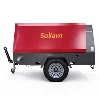
Sollant Diesel Portable Compressor
Electric Compressors: Efficient Where Power Is Available
An electric compressor is only as good as the supply behind it, and the supply must be checked rather than assumed:
Voltage, frequency and capacity must match. A motor wound for one voltage and frequency will not run correctly on another. Available capacity must cover the motor's full-load draw plus starting margin.
Starting current and cable configuration matter. Motor starting draws current well above running current, and cable sizing must keep voltage drop within the motor's tolerance over the actual cable run. Long runs on undersized cable cause nuisance trips and premature motor failure.
Best fit: factories and construction sites with stable power. Where a robust supply already exists, the electric unit avoids fuel logistics entirely.
Pro Tip: Before specifying an electric portable, confirm the supply at the exact point of use - not at the site entrance. Voltage, frequency, available fault current and cable distance all need to be verified against the motor nameplate.

3. Mobility and Installation: Which Compressor Is Easier to Move?
Mobility is often assumed to follow from the power source. It does not. It follows from the chassis, the undercarriage and the installation method.
Mobility Advantages of Diesel Portable Air Compressors
- Towable trailer configurations. Many diesel portables are built on road-towable trailers with brakes, lights and a towing eye, so they can be moved between sites behind a vehicle.
- Suited to outdoor and remote projects. No connection to a fixed electrical supply is needed at the destination, so relocation does not require a new electrical installation.
- Suited to frequent movement between job sites. The unit arrives ready to run once fuel is on board.
Mobility Considerations for Electric Compressors
- Requires access to a compatible power source at each location. The machine can be moved easily; the power supply cannot.
- Cable length and power distribution affect positioning. The compressor must sit within reach of a suitable supply point, and cable runs must be sized for voltage drop and protected from damage.
- Some portable electric models are easy to move within industrial facilities. Skid-mounted or pallet-truck-portable electric units move readily between bays where power is already distributed.
Towable vs. Stationary Configurations
Mobility is not determined by the power source alone. It depends on the chassis or skid, whether a trailer undercarriage is fitted, the unit's weight and dimensions, and whether the installation is fixed or temporary. A heavy diesel unit on a skid without a trailer is harder to reposition than a compact electric unit on casters. Conversely, a trailer-mounted electric compressor is highly mobile as an object but still tethered to a power point at each stop.
The practical question is not "which is more mobile" but "how far and how often must it move, and what is waiting at the other end?" A unit that moves 200 meters within a plant has different requirements from one that moves 200 kilometers between projects.
4. Operating Costs: Diesel Fuel vs. Electricity Consumption
Operating cost is where the two types diverge most sharply, and where site-specific inputs matter most. The comparison is not a fixed ratio; it depends on hours run, local fuel and electricity prices, and maintenance scope.
Diesel Compressor Operating Costs
- Diesel consumption. Fuel burn scales with load and engine size; hours run per year is the dominant variable.
- Engine oil and filter replacement. The engine carries its own lubrication and filtration service schedule, separate from the compressor airend.
- Engine maintenance. Belts, coolant, injectors, battery and exhaust aftertreatment all add service items that an electric motor does not have.
- Fuel transportation and storage. Remote sites need fuel deliveries, on-site storage and handling - a logistical cost that does not appear on the fuel invoice but is real.
Electric Compressor Operating Costs
- Electricity consumption (kWh). Energy use scales with load and hours, measured in kilowatt-hours rather than liters.
- Local electricity tariffs. The cost per kWh varies by region, tariff structure and time of use; industrial tariffs differ from residential.
- Motor and compressor maintenance. An electric motor has far fewer service items than a diesel engine - no oil changes, no fuel filters, no exhaust treatment - but the airend, coolers and controls still require scheduled service.
- Power infrastructure and installation costs. Cabling, switchgear, protection devices and any supply upgrade are capital costs that belong in the comparison.
Key Takeaway: Build the comparison on annual hours, measured or quoted fuel burn, local tariff, and the full maintenance scope for each type. A per-hour figure without those inputs is not a decision tool.
5. Operating Environments: Where Does Each Compressor Perform Best?
Outdoor and Remote Construction Sites
Diesel portables dominate here for a structural reason: the work moves and the power does not. Road, pipeline and earthworks projects advance along a corridor, and a fuel-driven towable unit follows the work face without a new electrical installation at each stop.
Mining and Drilling Environments
Mining and drilling share the remote-site characteristic, often with high duty cycles and harsh conditions. Diesel units are common because they operate independently of site power, which may be unavailable, unreliable or committed to other equipment. Where a mine has a robust distribution network, electric units can be viable, but the supply must be engineered for the load.
Indoor Industrial Facilities
This is electric territory. A diesel engine indoors introduces exhaust emissions and carbon monoxide risk. NIOSH guidance is explicit that gasoline-powered air compressors should be placed outside and away from air intakes so engine exhaust is not drawn indoors, and OSHA notes that carbon monoxide is produced when fuel combusts in powered tools, compressors and pumps. Where compressed air is needed inside a plant, an electric unit avoids the exhaust question entirely.
Hot, Dusty and High-Altitude Conditions
Both types face environmental limits, but differently. Dust loading affects intake filtration and cooling on either machine. High ambient temperature derates cooling capacity and, for diesel units, engine output. Altitude is a specific diesel consideration: a naturally aspirated combustion engine loses roughly 3% of its power per 1,000 ft of elevation gain, so a diesel compressor rated at sea level delivers less at altitude unless the engine is turbocharged or the unit is rated for the site elevation. Because this altitude derating directly affects how much air your tools will actually get, it's worth checking What size of diesel air compressor do I need for my pneumatic tools? before specifying a unit for a high-elevation site. Electric motors do not lose output with altitude in the same way, though cooling and insulation coordination still matter. For either type, confirm the manufacturer's ambient temperature and altitude ratings against the actual site.
6. Performance and Maintenance: What Should Buyers Consider?
Airflow and Working Pressure
Match the compressor to the tools, not the other way around. Establish the required free air delivery (FAD) at the actual working pressure, then add margin for leakage and future demand. Be careful with ratings: free air delivery varies with pressure setting, so a quoted flow figure is meaningless without the pressure at which it was measured. A unit rated at high flow at low pressure may deliver substantially less at the pressure your tools need.
Maintenance Requirements
Diesel units carry two service regimes: the engine and the compressor. Engine oil, filters, coolant, belts and exhaust aftertreatment add items and downtime. Electric units carry one regime - the compressor and motor - with fewer consumables but the same need for scheduled airend, cooler and control service. For both, confirm the manufacturer's stated service intervals and the availability of genuine parts in your region.
Noise and Emissions
Noise matters for both operator exposure and neighborhood constraints. OSHA's general industry noise standard (29 CFR 1910.95) and construction standard (29 CFR 1926.52) set exposure limits that may require hearing protection or engineering controls depending on measured levels and duration. Enclosed, sound-attenuated units reduce the burden.
Emissions are the sharper differentiator. Diesel engines are regulated for exhaust emissions, and units sold in regulated markets must meet the applicable tier or stage. Indoor or enclosed use of a diesel unit raises carbon monoxide concerns that electric units avoid. If the application is indoors, in a confined space, or near air intakes, the emissions question alone may decide the choice.
7. Diesel vs. Electric Portable Air Compressor: Side-by-Side Comparison
|
Criterion |
Diesel Portable |
Electric Portable |
|---|---|---|
|
Prime mover |
Diesel engine |
Electric motor |
|
Grid dependency |
None - self-powered |
Requires compatible supply |
|
Best power scenario |
Remote sites, no stable grid |
Plants and sites with stable power |
|
Mobility |
Towable trailers common; fuel on board |
Moves easily but tethered to power point |
|
Installation |
Fuel delivery and storage |
Cabling, switchgear, supply verification |
|
Energy cost basis |
Liters of diesel |
kWh at local tariff |
|
Maintenance scope |
Engine + compressor |
Compressor + motor |
|
Exhaust emissions |
Yes - regulated, CO risk indoors |
None at point of use |
|
Noise |
Engine noise plus compressor |
Compressor noise only |
|
Altitude effect |
Engine power loss unless turbocharged |
Minimal output loss |
|
Indoor suitability |
Poor without exhaust management |
Good |
Key Takeaway: The table summarizes tendencies, not rules. A trailer-mounted electric unit is more mobile than a skid-mounted diesel; a diesel unit with exhaust extraction can serve some indoor applications. Verify each criterion against the specific model and site.
8. Which Portable Air Compressor Is Right for Your Application?
Work through the decision in order, because each question can eliminate an option before the next one matters.
- Step 1 - Is there a compatible, reliable power supply at the point of use? If no, and a connection or generator is impractical, the answer is diesel. If yes, continue.
- Step 2 - Will the unit operate indoors, in confined spaces, or near air intakes? If yes, electric is strongly preferred on emissions and carbon monoxide grounds. If the work is outdoors, both remain viable.
- Step 3 - How far and how often must the unit move? Frequent moves between remote sites favor a towable diesel. Movement within a powered facility favors a portable electric.
- Step 4 - What are the annual hours and the local energy prices? High hours on a powered site tend to favor electric on energy and maintenance cost. Low hours on a remote site favor diesel on logistics.
- Step 5 - What airflow and pressure do the tools require? Confirm FAD at working pressure for the specific model, with margin.
- Step 6 - What are the environmental conditions? Check ambient temperature and altitude ratings; for diesel, check the altitude power derating and emissions compliance for the market.
Sollant supplies both portable diesel air compressors and mobile electric units, and can help match airflow, pressure and configuration to a specific site. If you are weighing the two for a project, an engineering review of your load profile, power availability and duty cycle is the most reliable way to settle the question before committing capital.
Diesel compressors are particularly suitable for mobile, outdoor and remote applications without reliable electrical infrastructure. Electric compressors are often a practical choice for facilities with stable power and indoor operating requirements. The final decision should consider total operating costs, airflow, pressure, environment and mobility - in that order of constraint, not in order of preference.