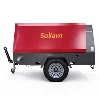
A 30, 50 and 100 HP rotary screw compressor are not three sizes of the same decision. They sit at different points on a plant's demand curve, and the wrong pick shows up as either a machine that never loads fully or one that runs flat out with no reserve. This guide gives US plant engineers, operations managers and procurement teams a defensible way to choose between them using three measured inputs: actual CFM, required PSI at the point of use, and the duty cycle the plant really runs.
The method is deliberately narrow. You will learn how to quantify demand rather than estimate it, how discharge pressure and system losses translate into energy, and how receiver storage covers peaks without forcing a bigger machine. From there the guide compares the three horsepower classes on fit and capacity, examines specific power and part-load behavior, and covers the installation and maintenance consequences that differ by size.
Use it as a shortlist tool, not a specification. Work through the sizing section with your own trend data, then use the comparison and decision checklist to eliminate one or two options before you request quotes. The goal is a compressor matched to measured CFM at the pressure your equipment actually needs, with the controls and storage that let it run efficiently across the whole shift.
Sizing the right screw air compressor
Sizing begins with measurement, not with a rule of thumb about horsepower per worker or per machine. Before selecting equipment, the most effective and reliable approach is to conduct a comprehensive assessment of both the supply and demand sides.Three variables drive everything that follows: air demand, air pressure and air quality.
Quantify CFM and duty profile
Demand is a flow rate over time, so a single peak number is not a duty profile. Log compressor input power, header pressure and flow across a full production week, including shift changes, breaks and washdown. Air-powered equipment varies significantly in its requirements: a 6-inch (approx. 15 cm) grinder, when operating at full load and 90 psig (approx. 6.2 bar), consumes 50 cfm (cubic feet per minute) of air, whereas a 1/4-inch (approx. 0.6 cm) drill for steel requires only 18–20 cfm. The actual air consumption of a tool depends on its "load factor"-the ratio of its actual air consumption to its air consumption at full load.Multiply each consumer by its load and duty factors, then add leaks and dryer purge air, which measured demand captures automatically but a component count does not.
Set PSI and calculate losses
Set pressure from the highest legitimate requirement at the point of use, then work backward through dryers, filters, separators and piping. The total operating pressure drop from the compressor outlet to the various points of gas consumption should not exceed 10% of the compressor discharge pressure.The energy penalty is steep and predictable: in a plant running near 100 psig, a 2-psig change in system pressure requires roughly a 1% change in compressor power for positive-displacement machines. Running the whole plant 20% higher to satisfy one point of use would cost about 10% more energy, plus increased artificial demand from every unregulated user.
Size storage for peaks
Storage decouples supply from short demand events. An ideal system should incorporate both "wet" and "dry" gas storage units, with a ratio of approximately 1:2 (i.e., 1/3 wet and 2/3 dry). The capacity of the dry gas storage units should be sufficient to ensure that the start-stop frequency of the compressor is limited to no more than about 10 times per hour.Size a dedicated receiver against the event itself: for a recurring 62-cfm draw lasting 15 seconds, the receiver must hold pressure above the application's critical minimum for the duration.
30 vs 50 vs 100 HP: fit and CFM
Equipment from different manufacturers, with varying pressure ratings and drive types, has different nominal capacities.As an order of magnitude, a 30 HP fixed-speed oil-injected screw typically delivers roughly 100–150 cfm at 100–125 psig, a 50 HP unit roughly 200–250 cfm, and a 100 HP unit roughly 400–500 cfm.
30 HP: where it excels
The 30 HP class fits plants whose measured average demand sits comfortably inside its capacity band with a modest peak margin. Typical matches are single-cell operations: a small machine shop with hand tools and one blast cabinet, a packaging line, a workshop with intermittent pneumatic actuation. Its advantages are a smaller electrical service, simpler ventilation, lower first cost and easier siting near the point of use - which shortens piping and reduces pressure drop. Its weakness is reserve. If measured demand already reaches 80% of capacity, any growth or a degraded dryer pushes the unit to run loaded continuously with no trim.
50 HP: balanced capacity
The 50 HP class is the middle option that suits plants with a clear base load plus regular variation - two-shift operations, multiple CNC cells, or a mix of tools and process air where demand swings by 30–50% across the day. It offers enough headroom to absorb growth and to carry a peak without a second machine, while remaining small enough that a VSD variant's turndown covers much of the daily swing. The trade-off is that a single 50 HP unit is a single point of failure; if uptime matters, the same capacity split across two smaller machines provides redundancy and better part-load staging.
100 HP: steady high demand
The 100 HP class belongs where measured demand is genuinely high and continuous - large process loads, multiple simultaneous users, or a plant header fed by several departments. At this size, efficiency and control strategy matter more than the nameplate: a fixed-speed 100 HP machine running unloaded half the day wastes far more than the price difference between drive types. This class also rewards planning. As general sizing guidance, a base-load machine paired with a smaller trim machine can cover a varying demand profile more efficiently than one large unit run well below capacity.
Energy efficiency and lifecycle cost
Purchase price is a minority of lifecycle cost. The vast majority of the electrical energy consumed by industrial compressors is ultimately converted into heat. This means that what determines your actual operating costs is not the rated full-load efficiency found on the equipment nameplate, but rather its operating efficiency under actual working conditions.Evaluate options on package specific power at the pressures and flows you measured, then add installation, air treatment, maintenance and expected service life.
VSD trim with base-load
Variable Speed Drives (VSDs) can match air demand by continuously adjusting the motor speed. However, VSD technology does not always offer an economic advantage; when operating at or near full load, the input power of a VSD-equipped unit can actually be higher than that of a fixed-speed unit of the same capacity, due to energy losses within the VSD system itself. Furthermore, at low operating speeds, the overall efficiency of the unit also declines.Best efficiency occurs when the VSD compressor runs between 30% and 80% of speed for most operating hours. The practical architecture is a fixed-speed base-load machine sized to the floor demand, with a VSD unit trimming the variation above it. Mixing variable-frequency units with fixed-frequency units can create a "control gap," potentially causing one unit to cycle on and off frequently, while the other remains in an unloaded (idling) state for extended periods. Selecting equipment based on the actual air demand profile can effectively prevent such issues. Shanghai Sollant Energy Saving Technology Co., Ltd. supplies PM VSD and two-stage screw compressor solutions.
Specific power and part-load
Specific power - kW per 100 cfm - is the comparison metric that survives differences in package size, because it normalizes output. Compare it at your required pressure, not at the catalog's best point, and compare it at part load if your profile spends time there. The choice of compressor and system control method is one of the most critical factors affecting system performance and efficiency. Simple control methods are suitable for operating conditions with stable demand, whereas systems involving multiple compressors and significant demand fluctuations require more complex control strategies.Ask for part-load data, not just full-load data.
Leak and pressure optimization
Leaks are the cheapest capacity you will ever find. In a well-maintained system, leakage should be kept below 5%–10% of the compressor's total capacity; in a poorly maintained system, however, leaks can result in a loss of 20%–30% of the compressed air capacity-along with a corresponding waste of energy. It also notes unregulated usage - leaks, open blowing - commonly runs 30–50% of demand, and every psi of excess pressure increases that consumption. A tagged, logged leak survey with a repeatable schedule often removes enough demand to change the horsepower decision outright, so run it before sizing.
Installation and maintenance
Installation choices made once constrain efficiency for the life of the machine. Location, power, ventilation, air treatment and service access all scale with horsepower, and the cost of correcting them later usually exceeds the savings from choosing a slightly cheaper compressor.
Power and ventilation by HP
Almost all compressor input energy becomes heat, so ventilation load scales directly with horsepower. For example, a 25-horsepower (HP) compressor operating at full load generates over 63,000 Btu (approximately 18 kW) of heat per hour; a 100-horsepower (HP) unit generates a correspondingly greater amount of heat. Duct the heat of compression away from the cooling-air inlet, or the fan recirculates already-heated air and the machine overheats. Keep room ambient above freezing and below about 105°F, and keep compressor discharge below the dryer's rated inlet (typically around 100°F). Size the electrical service and disconnect for the largest unit under consideration, and site the room near the power source to limit voltage drop and wiring cost.
Air quality, dryers, filters
Air quality is a system variable, not an accessory decision. First, determine the ISO 8573-1 purity class requirements for your production process equipment, then select the appropriate air treatment equipment accordingly-rather than blindly over-drying the compressed air supply for the entire facility. A refrigerated dryer typically reaches a pressure dew point around 37–50°F and suits general plant air; desiccant dryers reach far lower dew points where instruments or outdoor piping demand it. Filters add pressure drop, so size them for worst-case flow and temperature, not averages.
PM intervals and monitoring
Refer to the maintenance schedule provided by the manufacturer: make a copy of the schedule, record the date of each maintenance task and the name (or initials) of the person who performed it, and keep this copy near the equipment. Baseline power, pressure, flow and temperature when the unit is healthy; rising power at the same pressure and flow signals degrading efficiency. Oil and separator changes, filter differentials and dryer performance belong on the same log so trends are visible before failures.
Decision checklist and examples
Work through the three steps below in order. Each one closes a question the previous step leaves open: what the plant actually needs, which machine and controls deliver it, and whether the total cost holds up. Skipping a step is how plants end up with a 100 HP unit idling at 40 percent or a 30 HP unit that never catches up on the second shift.
Measure and model demand
Log actual flow and pressure for at least a full production week, covering every shift and the weekend. Measured data reflect total demand (including leakage), whereas demand derived through calculation requires an additional allowance for leakage. Record the maximum, the minimum and the shape of the peaks. For a new facility, assess a similar existing plant rather than estimating from tool counts.
Select HP and controls
Compare measured CFM at your required pressure against CAGI data sheets, then choose the smallest frame that covers peak demand with margin. If demand swings widely, pair a fixed-speed base unit with a VSD trim machine and check the control gap; if demand is steady, a single fixed-speed unit is simpler. Confirm storage volume and treatment capacity alongside the compressor.
Validate lifecycle cost
Build the case on annual kWh at measured duty, not nameplate horsepower. Add installation, treatment, storage, maintenance and expected service life, then compare options on simple payback and net present value as your finance team requires. A higher-priced VSD unit can win on part-load hours; a fixed-speed unit can win on steady three-shift demand. Document the assumptions so the comparison survives review.
Conclusion
Match horsepower to measured CFM at the pressure your process actually requires, and treat 30, 50 and 100 HP as three points on one capacity curve rather than a hierarchy. The 30 HP suits steady light demand and tight floor space; the 50 HP covers mixed loads with room to grow; the 100 HP earns its place only when base demand stays high enough to keep it loaded.
Before you commit, confirm three things. First, consider efficiency: request data sheets and compare the "package specific power" under your actual operating load-rather than relying solely on the ideal rated-condition data provided by the manufacturer.Second, installation: verify power supply, ventilation, floor tolerance and clearance, because a correctly sized compressor in a hot, starved room underperforms its rating. Third, service readiness: confirm local technicians, genuine spare parts and response times, since downtime cost usually exceeds the price difference between bids.
A shortlist built this way is defensible to operations and to finance. Measure first, size to the measurement, and let lifecycle cost settle the final choice.